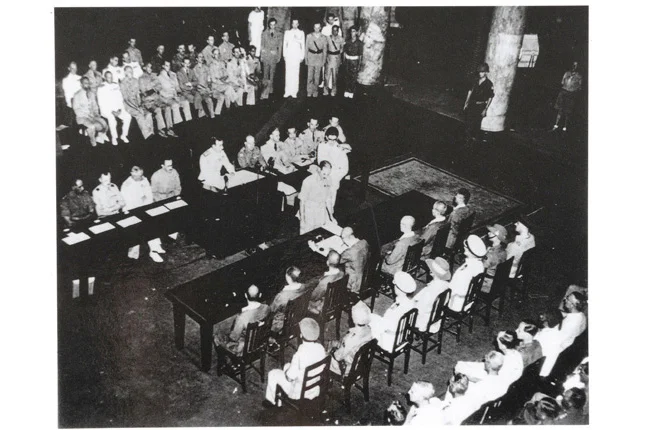
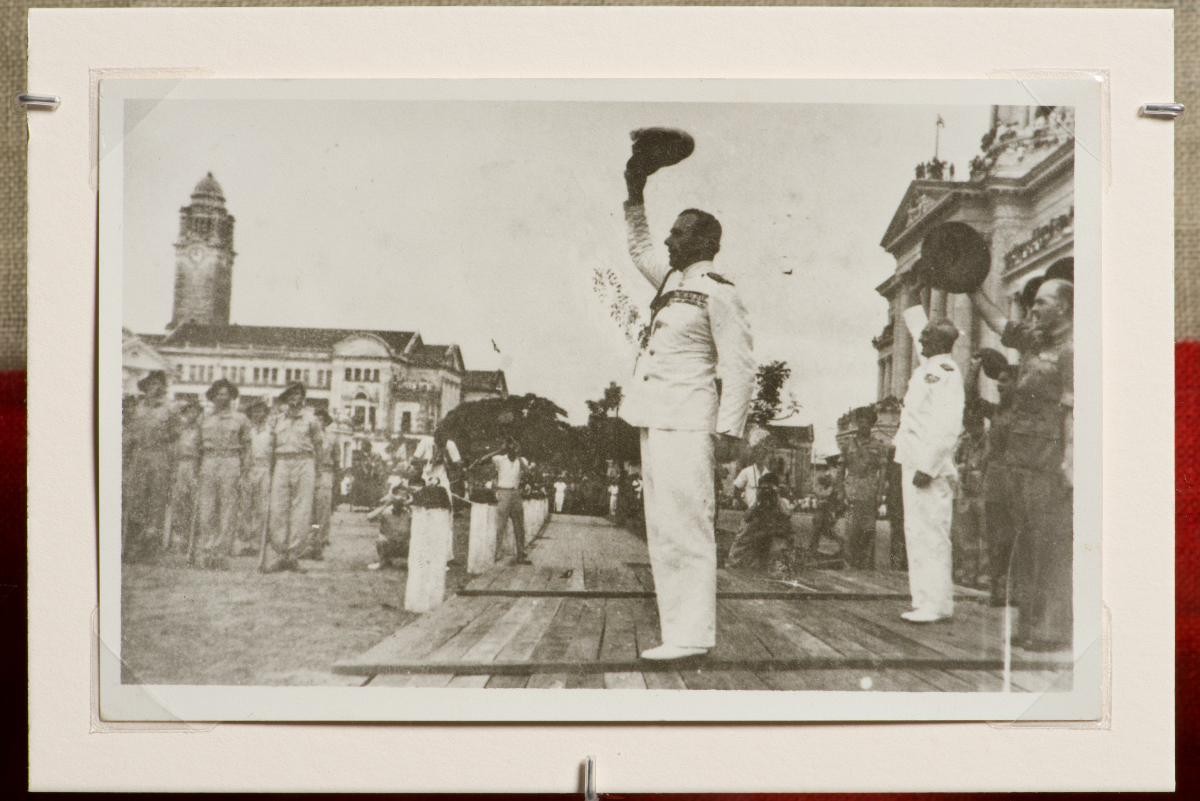
Formal surrender signed in Singapore 12 Sep 1945
Japanese forces formally surrender in Singapore at the Municipal Building, now City Hall.
While some couldn’t quite believe they’d survived, some were also thinking about who hadn’t.
Following the Japanese’s worldwide declaration of surrender on 15 August, the first surrender was to General Douglas MacArthur on board an American battleship, Missouri, at Tokyo Bay at 9 am on 2 September 1945. MacArthur also represented and signed for the Allied Powers, which entailed: The United States, Australia, Canada, New Zealand, China, France, Netherlands, and Russia. This marked the end of WWII.
Two weeks later, on 12 September 1945 at 11.10 am, local time, another Japanese surrender ceremony was held at the Municipal Building of Singapore (now known as City Hall), which was accepted by Supreme Allied Commander (Southeast Asia), Lord Louis Mountbatten.
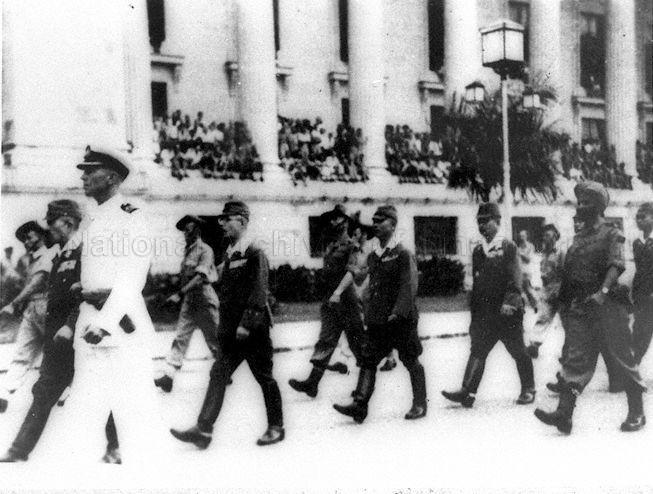
The euphoria of the ceremony was reinforced by the 400 spectators, which was made up of commanders and officers from the navy, army and air force, as well as senior officers from the Supreme Headquarters of the South East Asia Command, leaders of the Malayan communities, Sultan of Johore, Sir Ibrahim, and released prisoners-of-war, who were all seated behind the Allied representatives.
The surrender ceremony concluded with the waving of the Union Jack (flag of the United Kingdom) and the playing of the national anthems of all the Allied nations. The flag was the same one that had flown over Government House before the war. Throughout his captivity at Changi Prison during the Occupation, Malayan civil servant, Mervyn Cecil Frank Sheppard, had kept it concealed inside his pillow.
Throughout the surrender ceremonies, the Japanese signed a total of 11 copies of the Instrument of Surrender. One each for the British, American, Chinese, French, Dutch, Australian, Indian, and Japanese governments, along with one each for King George VI, Supreme Commander Mountbatten, and the South East Asia Command's records.