The Men Who Never Came Home:
Sook Ching and the Kempeitai
A modern day argument is if guys have it better than girls. Girls undergo monthly menstruations, pregnancy, birthing humans, and guys? Their only counter is NS. But pre-modern days? The guys might arguably have had the bigger leverage here. Disclaimer: Women across all ages suffered greatly during the war too, not just males. This is not to discredit that, but for the sole sake of highlighting the pain Males had to go through during the Sook Ching.
From 21 February to 4 March 1942, tens of thousands of Chinese males between the ages of 18 and 50 brutally tortured and executed by the Japanese in horrid, gruesome ways.
The exact number of people killed in the operation remains a mystery. The Japanese estimated that there were between 5,000 and 6,000 executions although the actual number is believed to be much higher. Allegedly, the plan was to kill 50,000 Chinese and half that number had been reached when the order was received to stop the operation.
Most historians and Singapore's first Prime Minister Lee Kuan Yew estimated that between 25,000 to 70,000 people lost their lives. Not soldiers or resistance fighters, they were teachers, shopkeepers, laborers, and students whose lives were ripped away for their identity as a Chinese in Japanese-occupied territory.
Right after word went around that home was successfully infiltrated by the Japanese, almost nobody dared to step out of the house. The streets were quiet like the lockdown during the Covid-19 pandemic that would emerge 80 years later. For a few days, there weren't even news publications as no one went to work.
Until one morning, there it is, my greatest nightmare manifests right before my eyes. From north south east west, in herds, the Japanese march down the almost deserted like streets. In about 4 days, notices and posters are seen up at every corner informing Chinese males between the ages of 18 and 50 to report to designated screening centres. Streets roar with loudspeakers spreading the new directive. Screening centres are being set up all over the island, and especially at almost every corner outside my house, located in Chinatown where large numbers of Chinese reside.
Word is going around the streets that the Japanese is targeting five main categories of Chinese:
1) members of the volunteer force
2) Communists
3) looters
4) those possessing arms and
5) those whose names appeared in lists of anti-Japanese suspects maintained by Japanese intelligence.
No one really knows what is about to happen at those screening centres. But with the Japanese at every corner and roads blocked at every street, would one really dare to defy such orders?
Pa, Kor, and I put on a brave front, leaving the house as if heading to the market for a morning trip. But there is this thick invisible force of fear and uncertainty that makes my feet heavy, dragging me back with every step.
The streets are loud with booming speakers and neighbours all moving in the same direction.
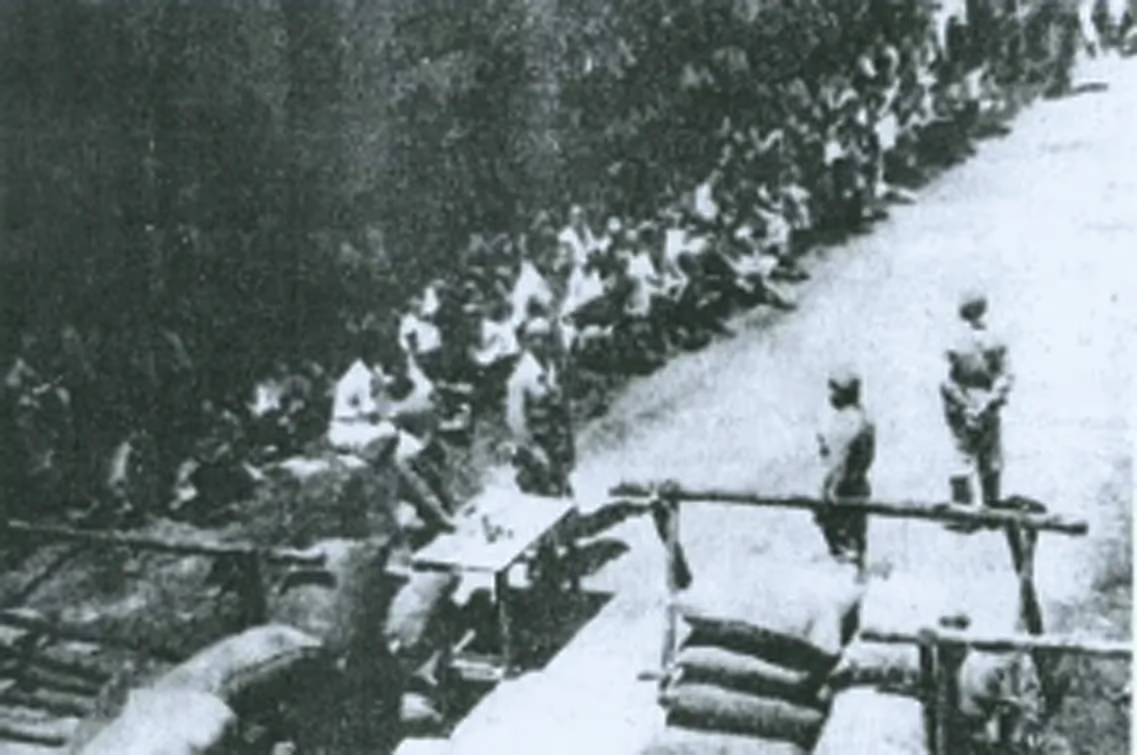
Stepping through the screened entrance into the open area of the camp, the Kempeitai, the Japanese military police and Imperial Guards stand around us, stoic, with menacing glares. We are immediately shoved into queues and hurried forward one by one, waiting outside a makeshift tent with several others.
Immediately shoved into queues and hurried forward one by one as we wait outside a makeshift tent with several others. Suddenly, Pa turns to grab me and Kor tightly, he sternly warns, “As soon as you two are allowed to leave, leave. Do not wait. Go home and find Ma.”
I’ve never seen Pa this serious before.. Before I can process what this could possibly mean, I am dragged away and brought to stand before a screening panel of unfriendly soldiers and interpreters. This includes some strange men who have their faces hidden behind hoods and speak only in whispers but do a lot of pointing with their fingers. It’s like the start of my afterlife where I stand between God and the Devil. Heaven or Hell, is it for me? Except I don’t even know what God looks like in this situation.
Maybe they saw me playing with the hem of my shorts or sensed my shaky breath that deemed me useless and of no threat. But after staring me up and down for what feels like eternity, they hand me a slip of paper before chopping it with a stamp, “examined.”
As I hurriedly leave the tent, I see Kor being interrogated and roughly checked up down for any tattoos. After a nod by the Kempetai, they stamp Kor on the shoulder and he quickly catches up to me. He drags me by the arm as we run out of the premises. I keep turning back, scanning the crowd for Pa. Several bald men everywhere. C’mon Pa... where are you?
As we reach the exit and turn for our home, I catch Pa at the corner of my eye. He squats in rows with other men in front of a truck, surrounded by soldiers with bayonets. Though afar, Pa tremblingly mouths me to “Go.”
Back home, Ma rushes up to us with perspiration soaking her neck. She carrasses my cheeks and breathes a sigh of relief but only for a moment as her eyes widen. “Where is Pa?” she questions with a raised voice. Kor and I stare at each other, searching for the right words.
Just then, Uncle Chiok, our neighbour runs into the house. Face as pale as a ghost, panting, he breaks the news: He saw Pa among the many loaded into the trucks and brought away.
Uncle Chiok was one of those who were unstamped too, the Japanese had touched his hands and chided it as too soft, a symbol of being educated. Rushed off to squat at the roadside, he saw trucks coming along to pick up those in the squatting group. Desperate to not succumb to whatever mysterious fate the truck would lead him to, he spotted a monsoon drain near where the trucks were lined up. As the last man in the group to climb up on to the trucks, he waited for his chance when the guards were not looking and then slipped quietly into the drain. As he hid in the drain, he saw Pa in one of the trucks driving away. After hiding there for hours till everyone had gone, he climbed out and made his way here stealthily. Miraculously, Uncle Chiok had escaped the Sook Ching.
Ma cries on for days, praying at the altar everyday. With Pa missing, hope is the only thing we can cling onto now.
For 2 weeks everyday, there are new reports of guys going missing. Almost everyone I know is affected, it’s just a matter of when. My teachers, relatives, neighbours, the mailman, my friends’ families, no one is spared.
I learn that those stamps given are now a form of lifeline, which must be preserved at all costs. It serves as proof of screening clearance whenever Japanese soldiers check on us. A ticket for survival.
The screening process appears unregulated and unsystematic. Judgments are based on the whims of the persons doing the screening. Hearsay, In some centres, victims are selected based on their occupations, whether the Kempetai like one’s answers to their questions, or whether they had tattoos.
In other centres, hooded informers, who I’m guessing are the ones who speak only in whispers but do a lot of pointing with their fingers, would point to men who are allegedly criminals or anti-Japanese. No proof, just according to the jurisdiction of fingers. That’s not even the most bewildering one, I heard that at the Jalan Besar centre, men who wear glasses are considered educated and, thus, guilty of having carried out anti-Japanese activities. Russian Roulette type.
There's an open secret on how to earn the stamp though. This one beggars belief, when they ask if you collect money for the China Relief fund. You got to say, "yes". The moment you say "no" they will say you are lying, and poof, you're gone. But don't get me wrong, this does not mean the Japanese are easy to fool. They've still got their own spies everywhere, so if you lie, just pray that you don't have one on your ass.
My friend, Cheong’s dad, was a local police officer. Cheong told me that the Kempeitai coerced him and a few other ordinary citizens into assisting the Kempeitai in such operations. As the Kempeitai are notorious for their inhumane interrogation techniques and unchecked power to arrest, torture, and execute civilians, he has no choice but to do whatever the Japanese orders them to do. He is not the only one as the Kempeitai are building an island-wide network of local informants who are generously paid for their loyalty and have no fear of arrest. These informants work at screening centers, helping to identify supposed anti-Japanese elements for elimination.
And when I say the Kempeitai are notorious, I mean, widely feared for their genuinely gruesome, shivers-down-the-spine methods. When extracting confessions, they use various torture methods with no proper trials.
Their interrogations go on for hours. Days, even. They wait it out in silence first, and if silence still doesn’t break you, something else will. Metal bars. Water forced down your throat until your lungs beg. Cigarettes pressed into skin. Limbs twisted in all directions. They keep going until they get what they want, or until there is nothing left of one to ask. Many captives die during torture and under harsh living conditions.
Not just that, forming the entire government, they are known for indiscriminate arrests of people with insufficient evidence. Those arrested by the Kempeitai are immediately assumed guilty and have little option of receiving civilian help and zero opportunities to appeal for clemency.
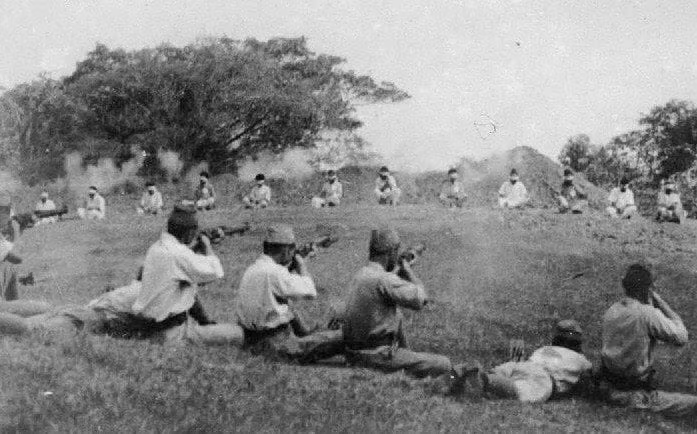
By now, it’s an open secret where the trucks lead to. At first there were rumours like "they were taken as labourers but for a few months only". I certainly am not a fool though. The trucks drive to remote beaches all over the island for execution. Allegedly, the details of such executions are not just a simple pulling of a trigger. Bound with rope in groups of 8 to 12, the suspects march towards the beaches before they are machine-gunned to death, and bodies thrown into the sea. Even litter gets more dignity than this. The British prisoners of war (POWs) and people living near the massacre sites are then tasked to bury the bodies.
With how many accounts there are of this, it can hardly be classified a secret anymore. But, perhaps it stays a secret for no one dares to face the truth that that is the real fate of our loved ones. Denial is a river in Egypt, they say, but same.
At this point, I have no more faith left in the Japanese. But just maybe there are still some morally decent ones, like a needle in a haystack. Kor’s good friend, Peck, describes what can only be an insane, God-given genuinely “God bless you,” miracle.
Peck is spared from the screenings through the intervention of a Japanese official, Mamoru Shinozaki, as he secretly issued personal protection cards to him and his family. We found out he’s the advisor of the defence headquarters, and actually, many others are also blessed by this god bless you, miracle. Apparently, he’s been giving out tens of thousands of “good citizen” cards, aka protection cards, without question to Chinese and Eurasians. These cards are supposed to be issued to Japanese collaborators and foreign diplomats only, and basically protects one from the Kemeptai.
When Peck told him that a friend was detained, Shinozaki even personally rushed to the screening centre, pulled rank on the Kempeitai officers, and secured the release of Peck’s friend and several other detained men.
The reason behind the Sook Ching massacre is quite easy to make out.
Firstly, the Japanese are suspicious of the Chinese in Singapore because of the deep rooted tensions between Japan and China, and also in view of the ongoing Sino-Japanese war. Since most of us only recently migrated from China down South not very long ago, many are still in close contact with relatives there. Hence, some even chip in money to the anti-Japanese movements in China or even volunteer to join the fight against the Japanese.
Kor also explains that after the fierce resistance by Chinese volunteers and guerrillas during the battles between the British and Japanese in Malaya, the Japanese want to eliminate any growing threat interfering with their affairs in Singapore.
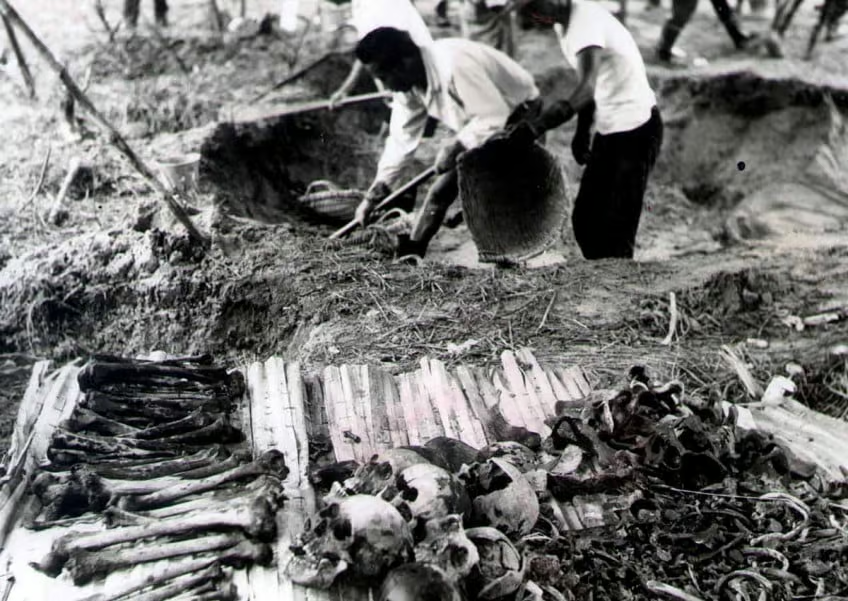
As such, the Kempeitai began the Sook Ching Massacre, to screen all anti-Japanese elements, segregate them and get rid of them promptly. But in practice, anyone perceived as challenging the Japanese or threatening law and order are labelled as being anti-Japanese.
Ma carefully describes, “Sook Ching” is a Chinese term, sù qīng, meaning purging through cleansing and the Japanese term is Dai Kensho, which means great inspection.
Some stories here are adapted from Mr Goh Sin Tub's recount.